Second Food Rescue

Branding, Graphic Design, UX/ UI Design, Web Design
Project Overview
Second Food Rescue is an organization focused on rescuing school leftovers. The organization needed am updated logo. They also needed an app to target users who can locate and register for food pick up. The organization needs a informational website for potential partners and other local non profits.

Take a peek at the old branding guide before the update.
Open here
My Contributions
Designer leading brand, app, and website design from conception to delivery. Conduction interviews, paper and digital wireframing, low- and fidelity prototyping, conducting usability studies, accounting for accessiblity and iterating on designs.
Platforms

Adobe Photoshop, Figma, Adobe XD

logo
App mockup
I used Second Rescue Food Data to develop interview questions. Which were used to conduct user interviews. Most interview participants reported feeling food insecurity at some point in their life and never thought about school food waste. The feedback received through the research made it clear that the users would be open to reducing food from their local school even if they didn't have food insecurity.
User Research:
Summary
October 2022 - November 2022
Persona 1 : Sam
Problem Statement:
Sam is a working parent who needs a way to obtain free food to help his family finances Because he is the only working adult in the family.
Persona 1 Sam
Persona 2 : Liz
Problem Statement:
Liz is a church leader in her church who needs free food resources because she helps with families in need.
Persona 2 Liz
Ideation
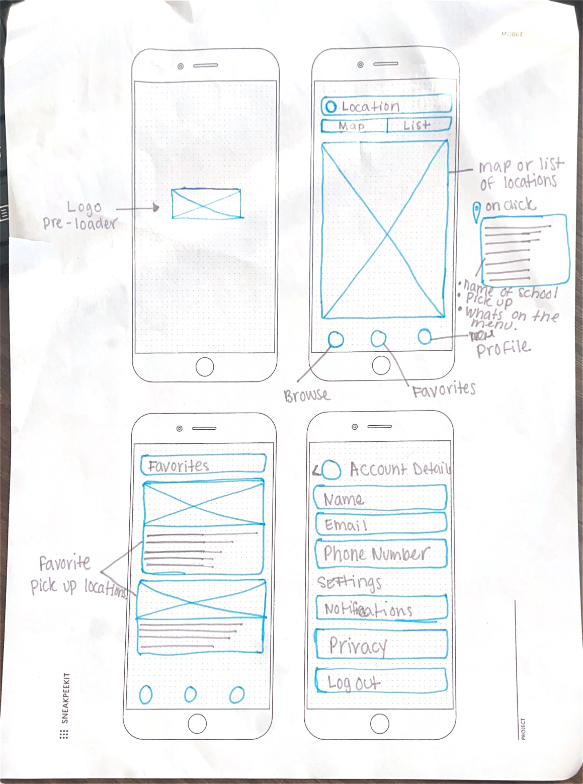
I did a quick ideation exercise to come up with ideas for how to address gaps identified in competitive audit. My focus was specifically finding locations and easy registration.
Ideation drawing
Digital Wireframes
After ideating and drafting some paper wireframes, I created the initial designs for Second Food Rescue App. These designed focused on delivering map view and list view locations for simple guided path for user.
Digital Wireframe
Low-Fidelity Prototype
To prepare for usability testing, I created a low-fidelity prototype that connected the user flow of creating an account, making a reservation, changing/ canceling a reservation, logging out, and deleting account. View Second Rescue Food low-fidelity prototype
Low - Fidelity Prototype
Usability Study: Findings

1. Users did not find an option to update reservation.

2. User were confused on how to close confirmation window.

3. Users did not find where to go to see reservation.

Mockups
Based on the insights from the usability studies, I applied design changes like providing a “Manage Reservation” button.
Low - Fidelity Mockup
High - Fidelity Mockup
Mockups
Additional design changes included adding a “I’m done” button and a sliding deck for a more clear process.
Low - Fidelity Mockup
High - Fidelity Mockup
High-Fidelity Prototype
The high-fidelity prototype followed the same user flow as the low-fidelity prototype, including design changes made after the usability study. View the Second Rescue Food High-Fidelity Prototype
High - Fidelity Prototype
Image of website
Sitemap
Sitemap
With the app designs completed, I started work on designing the responsive website. I used the Second Food Recuse sitemap to guide the organizational structure of each screen’s design to ensure a cohesive and consistent experience across devices.
Image of Sitemap
Responsive Design
The designs for screen size variation included mobile, tablet, and desktop. I optimized the designs to fit specific users needs of each device and screen size.
Image of responsive site

Next Steps

1. Add more resources for future partners.

2. Conduct more research on how successful the website is.

Takeaways

Impact:

Users expressed that the app and such program would greatly benefit the community. One user expressed that it would help with food waste but also help families with food insecurity. It is something that can be very helpful.

What I learned:

I learned that even though the problem I was trying to solve was a big one, diligently going through each step of the design process and aligning with specific user needs helped me come up with solutions that were both feasible and useful.